You bought into a vacuflo central vac because a dealer called it the upgrade pick, and now three filtration types and two mismatched wattage numbers for the same unit have you stuck. The catch keeping buyers confused is air watt inflation, a spec that rarely matches what reaches your farthest inlet.
Finish this guide knowing which Vacuflo family fits your home, which spec actually predicts performance, and which marketing line to ignore on the showroom floor.
Vacuflo Central Vac
A Vacuflo central vac is a whole-house system built on three filtration designs, True Cyclonic, Filtered Cyclonic, and disposable bag, all made by H-P Products, Ohio manufacturer building central vacs since 1955. Dirt moves through wall piping to a power unit, not a canister. It suits allergy and pet households.Why Vacuflo Confuses Almost Every First-Time Buyer
Vacuflo confuses buyers because it sells three filtration architectures under one brand name, each with its own venting rule, motor type, and price tier. Add inconsistent spec sheets across retailers, and most buyers choose on price alone, then discover the trade-off after the dealer has run pipe through the walls.
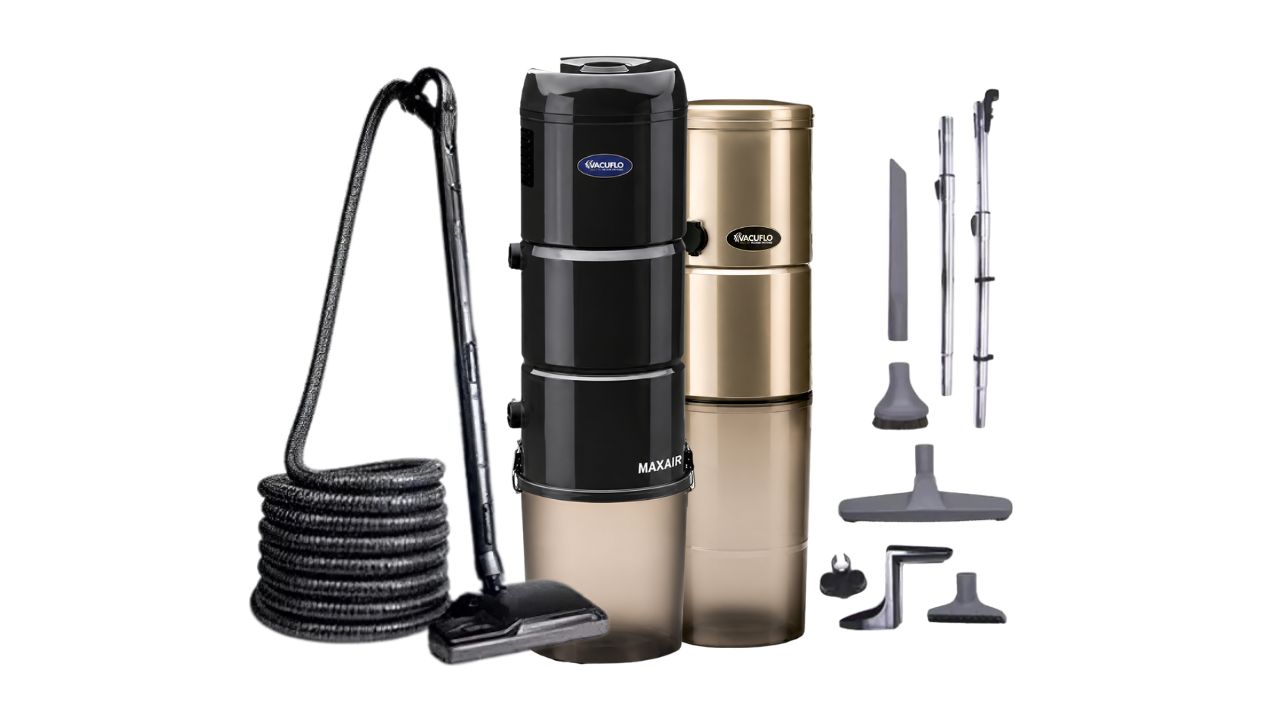
What Are You Actually Buying Here?
You’re buying a whole-house system, not a single machine, so the wall inlets and pipe network matter as much as the power unit in the utility room. Vacuflo is manufactured by H-P Products, Inc., based in Louisville, Ohio, building central vacuums since 1955, as confirmed by H-P Products, the manufacturer behind Vacuflo.
Most buyers fixate on the canister in the garage and ignore the pipe run snaking through the walls. A 700-air-watt unit feeding 90 feet of pipe and four elbows can lose more usable suction than a 500-air-watt unit feeding a tight 30-foot run with one elbow.
Why the Same Model Shows Different Specs
Retailers round air watt numbers up or quote them from different test points, so the same Vacuflo 566Q can show 535 air watts on one listing and a rounder number on another.
Every spec in this guide was cross-checked against H-P Products’ owner’s manuals and current retailer documentation, the same approach a CVAC-certified technician uses before quoting a job.
Before trusting any spec sheet, verify:
- Whether the air watt figure was measured at the motor or at the hose end.
- Whether the amperage matches the air watt claim. A unit pulling 28 amps for 886 air watts is a dual-motor design, not one efficient motor.
- Whether the listing names the actual test standard, ASTM F558, instead of just printing a number.
Trust the number with a stated test method behind it.
Is the Vacuflo Central Vac Right for You?
Vacuflo fits allergy households, pet owners, and multi-floor homes that want sealed suction kept away from living space. It doesn’t fit renters, studio condos, or anyone unwilling to deal with a dealer-only sales model.
Vacuflo also sells only through authorized dealers inside assigned territories, so a cheaper unit listed three states away can’t ship to your address, and buying through an unauthorized reseller voids the lifetime warranty outright. Renters can’t run PVC pipe through a landlord’s walls, and condos under roughly 1,200 square feet cover every room from one inlet anyway, so the added cost buys little a quality portable doesn’t already deliver.
Decoding Vacuflo’s Three System Families
Vacuflo splits its lineup into three filtration families, True Cyclonic, Filtered Cyclonic, and disposable bag units, and that family decides whether you vent outdoors, swap a filter, or empty a bag. Picking the family comes before picking a model number.
True Cyclonic Vents Outside, No Filter Needed
True Cyclonic units spin dirt out of the airstream by centrifugal force alone, so there’s no bag or filter to maintain, but the unit must vent through an exterior wall. The family includes the 260, 466Q, 566Q, 760, and MaxAir.
Cyclonic separation captures roughly 96 to 98 percent of debris in the canister, but the remaining fine dust has to vent outside through a dedicated port. Skip that vent for a closed garage instead, and within a season a fine gray film coats shelving in whatever space absorbs the recirculated air.
Even the entry-level end of the family, like the budget-friendly Vacuflo 560 option, skips the bag and filter the same way the flagship 760 does. The trade-off is a literal hole in an exterior wall, which not every HOA or historic-district homeowner can get approved.
Filtered Cyclonic Skips the Outdoor Vent
Filtered Cyclonic units add a cartridge filter after the cyclone stage, so exhaust can vent indoors into a garage instead of outside. That convenience comes with a filter to clean or swap on a schedule.
| Model | Home Size Coverage | Notable Spec |
|---|---|---|
| FC300 | Up to 2,500 sq ft | Compact condo and apartment unit |
| FC550 | Up to 5,000 sq ft | Mid-size single-family homes |
| FC650 | Up to 8,000 sq ft | 575 max air watts, single motor, dedicated 20-amp circuit |
Coverage ratings only tell part of the story, since condo-tier units cost less but also seal less air. For the full breakdown of what Vacuflo central vacs actually cost across all three families, price is the fastest way to guess which tier a unit belongs to. The filter itself is the catch competing dealer pages skip: the cartridge needs periodic cleaning, or it starts restricting airflow before the canister fills.
Bagged Maxum Units Keep Dust Contained
The Maxum disposable bag line, DB3000 through DB9000, captures debris inside a sealed bag instead of a bin, so emptying never kicks dust into the air. The trade is a recurring bag cost that True Cyclonic and Filtered Cyclonic owners never pay.
The DB7000 pulls a maximum 14.8 amps for 601 air watts, fitting a single dedicated 20-amp circuit under NFPA 70’s branch-circuit rules, unlike the dual-motor 760’s 28.4 amps. Multi-pet households land on the heavy-duty Vacuflo DB7000 bypass unit for this reason: bypass cooling plus bag containment means less mess at every emptying, though bags run a few dollars each.
True Cyclonic Versus Filtered Cyclonic Honest Trade-Offs
True Cyclonic wins on long-term maintenance since there’s no filter or bag to replace, but it demands an exterior vent. Filtered Cyclonic wins on installation flexibility since it can sit in a sealed garage, but the cartridge filter becomes a maintenance item dealers rarely mention upfront.
Do You Have to Vent a Vacuflo Outside?
Yes, if your choice is True Cyclonic. The cyclone stage can’t trap every particle, so the unit pushes its exhaust air, fine dust included, straight outside through a dedicated port. Filtered Cyclonic and disposable bag units don’t carry this requirement and can exhaust indoors instead.
A True Cyclonic system vented into a closed space recirculates the exact dust it was designed to remove. Vented outside, that same dust never re-enters the home at all.
Why FC Filter Seals Fail Over Time
Filtered Cyclonic seals fail when the gasket between cartridge and canister hardens or shifts, letting fine dust bypass the filter and reach the motor fan, a quiet failure that shortens motor life years before the warranty ends.
A loose seal lets dust settle on the spinning fan blade, throwing it off balance the way a dirty ceiling fan wobbles at high speed. That imbalance wears the bearing faster and runs the motor hotter every session. Inspect the gasket whenever the filter comes out; it’s a five-minute check most manuals barely mention.
Which One Keeps Allergens Out of Your Air?
Filtered Cyclonic and disposable bag units keep more allergens contained inside the home’s mechanical space, but no Vacuflo unit on the market, including True Cyclonic, carries certified HEPA status. True Cyclonic sends roughly 2 to 5 percent of fine dust outside instead of recirculating it indoors.
HEPA filtration, by the EPA’s definition, requires capturing 99.97 percent of particles at 0.3 microns, a bar no Vacuflo filter media is certified to meet. For asthma and allergy households, venting that residual dust outside the building beats trapping it in a filter that needs human hands to clean.
The spec everyone misreads comes next.
The Air Watts Number Dealers Love to Quote
Air watts measure airflow times suction at a single test point, not the cleaning power you’ll feel at an inlet 50 feet away, and dealers quote the flattering number without context. The Vacuflo 760’s 886-air-watt rating is the clearest example of a spec that needs translation before it means anything.
What 886 Air Watts Really Means
Air watts equal CFM multiplied by water lift divided by 8.5, the formula set by ASTM F558 and referenced across AHAM’s appliance testing standards. The Vacuflo 760’s 886-air-watt rating comes from a dual-motor design pulling 28.4 amps, not one efficient motor, a detail dealers leave off the spec sheet.
A single-motor FC650 rated at 575 air watts on 15.7 amps does more work per amp than the dual-motor 760’s 886 air watts on 28.4 amps. Comparing the two without accounting for motor count is the most common mistake in any spec comparison, and even dealers make it. Inside the True Cyclonic family, the powerful Vacuflo MaxAir series sits alongside the 760 as the other multi-motor option for homes past 8,000 square feet, where single-motor units lose the suction battle at the farthest inlet.
That extra power draws a heavier toll on the electrical panel: the National Electrical Code, NFPA 70 Article 210, requires a dedicated branch circuit sized to a unit’s full maximum amperage, not a standard 15-amp household line.
Air Watts Versus Suction at the Hose
Air watts measure suction at the power unit, not at the end of your hose. Water lift, the pull that actually lifts debris off carpet fiber, drops with every foot of pipe and every elbow between the inlet and the motor.
A fire hose makes the point: pressure at the truck tells you almost nothing about what comes out the nozzle after 100 feet of hose and three turns. A central vacuum’s pipe network behaves the same way.
How Distance From the Unit Steals Power
Suction drops with every 10-foot pipe run extension and every 90-degree elbow added beyond the manufacturer’s specified maximum, so the inlet farthest from the power unit always performs worse than the one closest to it. Keep daily-use cleaning within roughly 35 feet of the power unit for suction that still feels strong at the hose end.
Map a single-story ranch with the power unit in a garage at one end and the farthest bedroom inlet 70 feet away through four elbows; it will noticeably underperform the hallway inlet sitting 20 feet from the same unit.
The “5x More Powerful” Claim, Examined
Vacuflo markets its systems as performing up to five times more powerful than a standard portable vacuum, a comparison measured motor-to-motor, not at an inlet after a long pipe run. The number is real as a motor comparison; it isn’t a promise about what you’ll feel 60 feet down the line.
Power at the unit rarely survives the trip to your floor unchanged. Ask any dealer quoting that figure where it was measured.
Motors, Reliability, and What Really Wears Out
Every Vacuflo power unit runs on an Ametek Lamb motor, the same motor supplier used across most of the central vacuum industry, so reliability comes down to motor design and maintenance, not brand badge.
Every Vacuflo Runs on Ametek Lamb Motors
Ametek Lamb supplies the motors inside Vacuflo power units, the same motor maker behind most other central vacuum brands on the market. That shared supply chain keeps replacement motors and rebuild kits affordable industry-wide, regardless of which badge sits on the canister, good news for repair costs fifteen years into ownership.
Bypass Versus Thru-Flow, Why It Matters
A bypass motor pulls in a separate stream of clean air to cool its windings, keeping dust away from the motor entirely. A thru-flow motor cools itself by running dirty working air over the windings, which historically wore out faster as grit built up. Modern thru-flow designs have closed some of that gap, but bypass motors, the design across Vacuflo’s True Cyclonic and DB units, still keep abrasive dust off the parts that spin fastest.
How Long Do Vacuflo Motors Actually Last?
Owners report fifteen years or more from a well-maintained Filtered Cyclonic unit, with True Cyclonic owners reporting a few years beyond that thanks to bypass motor design. Across owner forums and dealer logs, the pattern repeats: an FC unit cleaned twice a year still runs at fifteen, while a neglected one with a hardened seal needs a new motor by year eight.
That range starts with where you put the inlets.
Living With a Vacuflo Day to Day
Daily convenience comes down to two things dealers rarely walk through: where inlets sit relative to your furniture layout, and how clean the canister empties when full. Get both right and the system disappears into the routine; get them wrong and it becomes the vacuum you avoid using.
Inlet Placement Makes or Breaks Convenience
Count inlets by square footage covered per floor, not by the whole-house total, since a single inlet on each level rarely reaches every room with a standard 30-foot hose. A poorly placed inlet means dragging hose up a staircase every cleaning session.
Center one inlet per level in a two-floor, 2,400-square-foot home, and every room stays within hose reach. Place it near the front door instead, for installer convenience, and the back bedrooms fall outside range. Open floor plans and finished basements need a layout beyond the standard count; our guide to custom Vacuflo vacuum builds maps coverage room by room first.
Emptying the Canister Without the Dust Cloud
Lift the lid on a full True Cyclonic canister and a puff of fine gray dust rises into the air, the same dust the cyclone separated but never fully sealed away. Disposable bag units skip this entirely since the bag lifts out sealed.
Empty a True Cyclonic canister outdoors, or hold a bag open underneath it, and that dust never reaches your lungs. Skip that step enough times, and the canister area collects a fine film nobody connects back to the vacuum.
Repair or Replace Your Aging Vacuflo Unit
Replace the motor when the canister, tubing, and inlets are still sound, since a $200 to $300 motor swap can add another decade to an otherwise healthy system. Replace the whole unit once the canister cracks or the control board fails, since those repairs cost close to a new power unit anyway.
When a Motor Swap Still Makes Sense
A motor swap makes sense when the pipe network, inlets, and canister are intact and only the motor has worn out after twelve to twenty years of use. Skip it if the canister has cracked or the circuit board shows signs of failure.
Before agreeing to a full replacement, confirm:
- The dirt canister has no cracks or warping.
- The PC board powers on and holds steady through a full cleaning cycle.
- The existing pipe diameter matches what a new power unit requires, since some older systems used a narrower bore.
What the Lifetime Warranty Actually Covers
The Vacuflo limited lifetime warranty covers permanently installed components, motors, circuit boards, the dirt canister, tubing, and standard inlet valves, for as long as the original buyer owns that home. Only the first year includes free labor; after that, you pay the dealer’s labor rate. Read the Vacuflo’s official limited lifetime warranty terms before assuming lifetime means free forever.
The warranty does not transfer to a buyer who purchases the home later; it belongs to the original installation and owner only, and ends the moment the system leaves that house. Consumables like bags, filters, and motor brushes carry no coverage at all, and buying from anyone other than an authorized dealer voids the entire warranty on the spot.
Are Parts Still Easy to Find?
Yes. Vacuflo uses universally compatible 2-inch fittings, hoses, and attachments, and even the discontinued 260 has documented motor cross-references, a real reason to keep an older unit rather than replace it.
Standard 2-inch Vacuflo fittings are compatible with most North American systems, including Beam, Drainvac, CycloVac, and OVO. The exception: some vintage Sears and Kenmore installations used a non-standard bore that needs an adapter before a modern hose seats properly.
For condos and tight hallway closets, compact models in the Vacuflo Edge range of powerheads and attachments fit inlets where a full-size turbine brush won’t clear the baseboard.
Is Dirt Devil Central the Same Machine?
Mostly, yes. Dirt Devil, manufactured under license by H-P Products alongside Royal and Element, uses the same Filtered Cyclonic engineering as Vacuflo’s own FC line, just under a different badge and price point.
Royal and Element come off the same Ohio production line. Paying extra for the blue Vacuflo badge buys the company’s dealer network and warranty registration, not a meaningfully different machine underneath.
Sizing the right unit comes last.
Buying Smart: Matching a Vacuflo to Your Home
Match the power unit’s rated square footage to your actual floor plan, then choose filtration family before chasing a bigger air watt number, since the wrong filtration choice costs more over ten years than the wrong wattage ever will. Buy a unit rated above your home’s size, not at the exact number on the box.
Start with selecting the right Vacuflo power unit for your square footage and floor count before comparing model numbers. The family decision narrows the field faster than any spec sheet.
Size by Square Footage Per Floor
Halve the square footage rating printed on the box, since dealer ratings assume ideal pipe runs with minimal elbows most real homes don’t have. The 566Q is rated to 8,000 square feet, but a long, elbow-heavy layout should treat that closer to 4,000.
Best Vacuflo central vacuum for 3,000 sq ft? The FC550 or 466Q, sized up rather than down, buys a margin most single-motor units need.
Buy a unit rated larger than your actual home for suction that still feels strong at the inlet farthest from the power unit, especially past three 90-degree turns.
Pick Your Filtration Before Your Model
Decide between True Cyclonic, Filtered Cyclonic, and disposable bag before comparing models, since the filtration family decides your installation cost and maintenance routine for the next twenty years. Allergy households do best with True Cyclonic vented fully outside.
Garage installs without an exterior vent option lean toward Filtered Cyclonic instead. For the full spec rundown, our complete Vacuflo FC650 breakdown covers exactly where that model’s 575-air-watt rating holds up and where it doesn’t.
Questions to Ask Before You Sign
Ask three questions before signing any Vacuflo contract; the answers tell you more than any brochure. A dealer who hesitates on any of these is one to walk away from.
- What exact air watts rating applies, and was it measured at the motor or at the hose end?
- Is the motor a bypass or thru-flow design, and does that match what the warranty document lists?
- Who services this unit locally, and how fast do replacement parts ship if the canister or board fails?
Conclusion
You arrived unsure whether a vacuflo central vac was one machine with one impressive number, and you leave knowing it’s a choice between three filtration families with real trade-offs in venting, maintenance, and cost. Measure your pipe-run distance and inlet count tonight before calling a dealer back. A right-sized Vacuflo, matched to your square footage and filtration needs, runs quieter and longer than any portable you’ve hauled upstairs, for twenty years without a single bag change on True Cyclonic.
Frequently Asked Questions
Who makes Vacuflo central vacuums and where are they made?
Yes, entirely in the US. H-P Products, Inc. builds every Vacuflo power unit in Louisville, Ohio, and has since 1955.
What is the difference between Vacuflo True Cyclonic, Filtered Cyclonic, and disposable bag units?
True Cyclonic spins dirt into a bin and vents outside with no filter, Filtered Cyclonic adds a cartridge so it can vent indoors, and disposable bag units bag the dirt so emptying stays clean. Pick based on whether you can cut an exterior vent hole, not on the air watt number.
Does a Vacuflo central vacuum need to vent outside?
Only if you choose True Cyclonic. That family has no filter to catch fine dust, so it has to exhaust outside; Filtered Cyclonic and disposable bag units can vent into a garage or utility room instead.
Is the Vacuflo lifetime warranty transferable to a new homeowner?
No, the lifetime warranty stays with the original buyer at the original home. Sell the house, and the new owner starts from zero, so ask the seller for the install date and service records first.
Are Vacuflo filters and bags true HEPA?
No, not certified. Vacuflo’s filters and bags trap most fine dust, but none carry official HEPA certification, which requires capturing 99.97 percent of particles at 0.3 microns under EPA-referenced standards.